
The answer isn’t to spend more. It’s to compete smarter — in places the big players can’t follow.
You searched your own name. Or your service category. And there they were. Angi. HomeAdvisor. A regional chain with a marketing department. Maybe a franchise operation that’s been here for three years and somehow already dominates the first page.
It’s a frustrating thing to stare at. You’ve been doing this work in Southern Maryland for years. You know the area. You do quality work. Your existing customers would tell anyone who asked. And yet — on the search results page, you’re invisible. So the question that comes up is natural: How do I compete with that?
Most contractors assume the answer is money. Bigger ad budget. More spend on Google. Pay for leads. That’s the wrong answer. And if you’ve already tried it, you probably know why.
The Real Reason the Big Guys Are Winning
The national brands and lead aggregators aren’t ranking because they’re better at what they do. They’re ranking because they’ve invested heavily in broad search terms — “plumber near me,” “HVAC company,” “contractor in Maryland” — terms with enormous search volume where they can pull in leads from a wide net and resell them.
That model works for them because they’re not actually doing the work. They’re selling access. Every time you buy a lead from one of those platforms, you’re funding the very machine that’s outranking you.
But here’s what that model has a fundamental weakness in: local specificity.
A national lead aggregator cannot be genuinely, deeply local. They can have a page that mentions “Southern Maryland” — but they can’t have 60 reviews from actual homeowners in Lexington Park and Prince Frederick and Waldorf. They can’t have content that speaks to the specific problems homeowners face in this area. They can’t have a Google Business Profile with years of consistent activity in a single, defined service territory.
That local specificity? That’s your lane. Most small contractors just aren’t running in it.
Stop Competing Where You'll Lose
The first strategic shift is the most important one: stop trying to win the broad search fight.
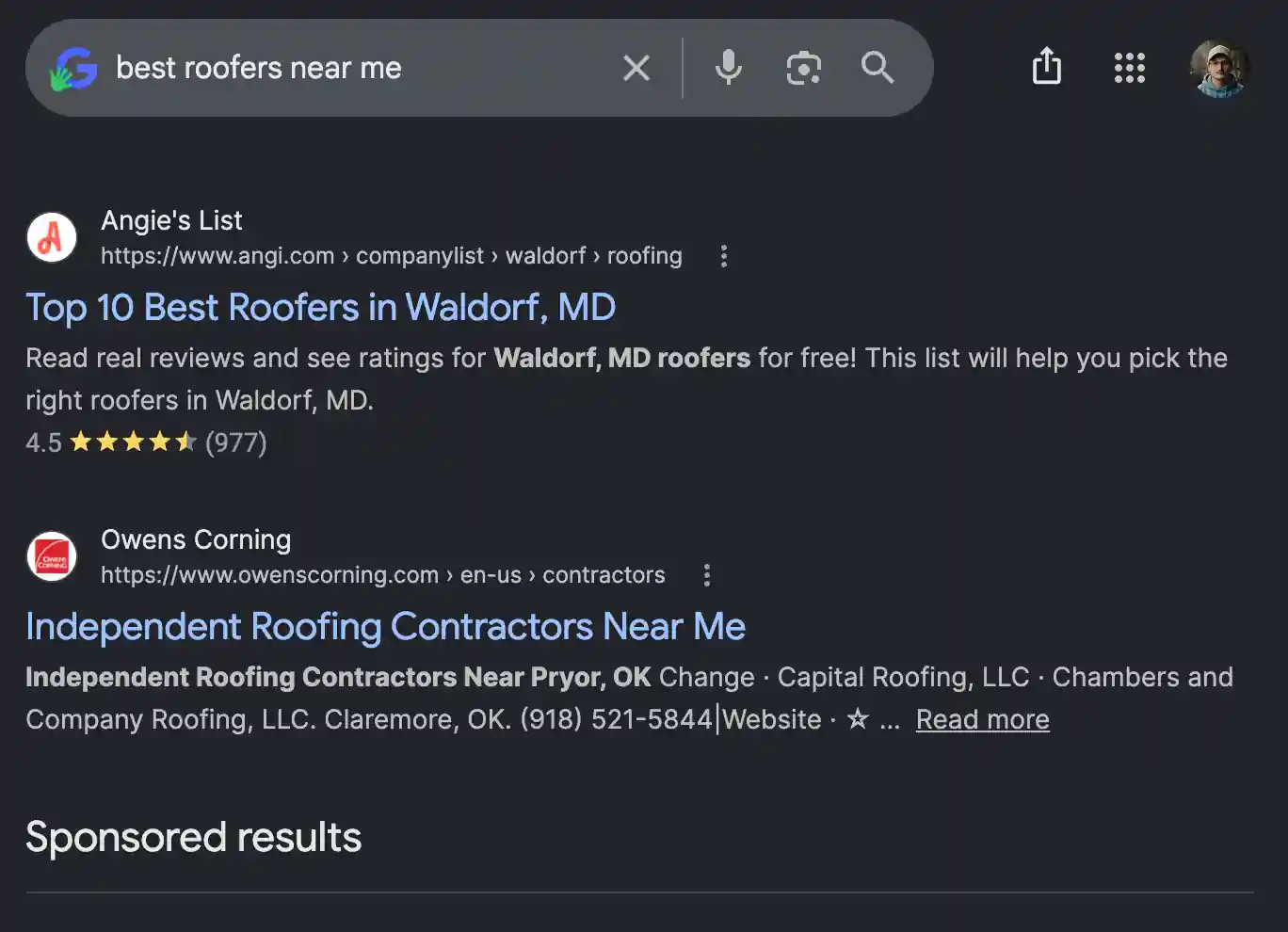
If you’re spending money trying to rank for “plumber near me” or “HVAC contractor Maryland,” you’re competing on the national brands’ home turf with their rules and their budget. You’ll lose that fight, and it’ll cost you to lose it. Instead, win the specific fight. “Water heater replacement in Waldorf.” “AC tune-up in Leonardtown.” “Emergency plumber in California, MD.” “Furnace repair in La Plata.”
These are the searches that have high buyer intent — people who know exactly what they need and where they need it — and the national brands are either not showing up at all or showing up with generic content that doesn’t inspire confidence.
That’s ground you can take. And holding that ground is far more valuable than fighting over “plumber near me.”
Build Authority in a Tight Geography
Search engines decide who to show based on a combination of relevance and trust. The more clearly your entire online presence signals that you are the contractor for a specific service in a specific area, the more Google rewards you with visibility.
This means a few things in practice:
Your Google Business Profile matters more than most contractors realize. It needs to be fully built out — service areas defined, categories set correctly, photos active, and most importantly, reviews coming in consistently from real customers in your service area. A profile with 60 reviews from homeowners in St. Mary’s County is dramatically more powerful than one with 8 reviews and no photos.
Your website needs real local content — not boilerplate. A service page that says “we serve Southern Maryland” is not the same as a page that explains what a homeowner in Prince Frederick should know about their water quality when it comes to plumbing maintenance, or why the humidity levels in Calvert County make certain HVAC maintenance more important. That kind of specificity is what search engines reward — and what out-of-area competitors can never replicate.
This is also where AI is quietly leveling the playing field — and creating a new problem at the same time. Large companies are now using AI to generate hundreds of location pages at scale. Generic, fast, cheap. The catch: AI-generated content that isn’t grounded in real local knowledge reads like it was written by someone who’s never been here. Search engines are getting better at identifying it, and homeowners definitely notice. The answer isn’t to avoid AI — it’s to use it to produce content that’s actually specific, informed by what you know about your market, your service area, your customers. That’s something a national brand pumping out templated pages simply can’t replicate.
Reviews are search infrastructure, not just social proof. Every review that mentions your service area, your specific work, your crew by name — that’s organic content that builds authority and trust signals simultaneously. A contractor with 75 reviews from local homeowners isn’t just winning on reputation. They’re winning on search.
And this is one place AI genuinely can’t help the big guys. Reviews have to be earned. They can’t be generated, automated, or purchased at scale without Google catching on. When a homeowner in Waldorf writes that your tech showed up on time, fixed the problem right, and left the place clean — that’s a trust signal no algorithm can manufacture. It’s also exactly the kind of signal Google is increasingly weighing when deciding who deserves to show up first.
Build Something That Gets Cheaper Over Time
This is the part of the conversation that most agencies don’t want to have, because it’s not in their interest.
Most lead generation for contractors works like a treadmill. You pay Google per click. You pay HomeAdvisor per lead. You pay the agency to manage the ads. And all three bills arrive every month — and none of them decrease. In fact, as competition increases in your category, the cost per lead tends to go up.
The moment you stop paying, the phone stops ringing. There’s nothing left. You haven’t built anything.
Organic search works on a completely different model.
Every review you earn is permanent. Every piece of local content that gets indexed builds on itself. Every month your Google Business Profile is active and reviewed and engaged with, it becomes a stronger signal. The authority you build compounds.
That doesn’t mean there’s no work — building organic authority takes consistent effort and a clear strategy. But the payoff is a lead pipeline where your cost per lead decreases over time. Where you’re not paying Google for every single phone call, indefinitely. Where the marketing you’ve invested in keeps working while you’re on the job.
Paid ads have a place — for seasonal pushes, a new service area, filling capacity gaps. But they work best as an amplifier for a foundation that already exists, not as the only thing holding the phone together.
The Small Contractor Advantage
Here’s the thing that often gets lost in conversations about competing with big companies:
You have something they can’t buy.
You’re actually here. You know which neighborhoods have older infrastructure. You’ve worked on houses in every county. Your crew is local. Your reviews are from real homeowners your customers can call. When someone searches for a contractor and finds you, they find a business that is genuinely part of this community — not a brand that has a landing page here.
Here’s where it gets interesting with AI: the big companies are now using it to generate content faster than ever. Hundreds of city pages. Templated service descriptions. Automated follow-up sequences. And on the surface, it looks like a budget problem for small contractors — how do you keep up?
You don’t compete on volume. You compete on truth.
AI can write a page about Lexington Park, MD. It cannot know that a lot of the homes off Route 235 are on well water and have specific plumbing quirks. It cannot know that the older neighborhoods in La Plata have infrastructure patterns that affect HVAC system sizing. It cannot know what your customers are actually calling about, what questions they ask before they book, what worries them about hiring someone new. You know those things. And when that knowledge shows up in your content, your reviews, your Google Business Profile — it creates a signal that no template can fake.
The AI wave isn’t making local expertise irrelevant. It’s making it more valuable, because generic content is about to get a lot more generic.
That is a competitive advantage. The question is whether your online presence reflects it.
If your search footprint is thin — a basic website, a half-built GBP, a handful of reviews — you’re leaving that advantage unclaimed. The big companies are showing up because they’ve invested in showing up. You can outcompete them in your own backyard, but you have to actually compete.
Where to Start
If your phone isn’t ringing the way it should, and you’re not sure whether your current marketing is building anything that compounds, here’s a starting point:
Search your own services in your own service area. Look at who’s ranking. Look at their reviews, their content, their GBP activity. That’s the benchmark.
Then ask yourself: does my online presence tell a more specific, more local, more credible story than what I’m looking at?
If the answer is no — or if you’re not sure — that’s the conversation worth having.
We work exclusively with home service businesses in Southern Maryland. We build organic search systems designed to fill your schedule with quality, in-area jobs — without paying Google per lead.
Book a Free Strategy Call → We’ll look at your current search presence and tell you exactly where the opportunity is.